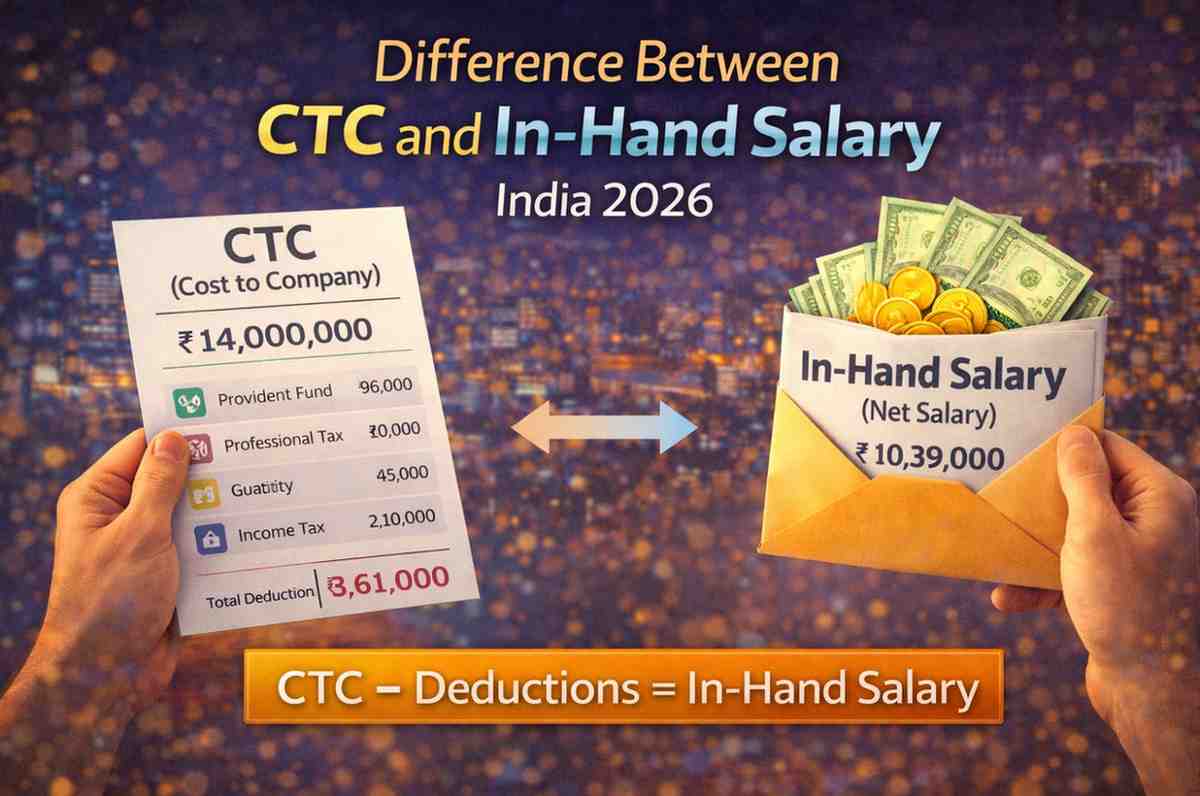

It is a moment of pure joy. You clear the final interview, the HR calls you, and sends that golden email: “Congratulations! We are pleased to offer you a package of ₹6 Lakhs Per Annum (CTC).” You immediately pull out your calculator. ₹6,00,000 divided by 12 months equals ₹50,000 per month. You start dreaming about buying a new bike or renting a nice apartment. But then, the first month ends, and you get a notification from your bank: “Salary Credited: ₹38,000”. You are shocked. Where did the remaining ₹12,000 go? Did the company cheat you? Did you make a mistake?
Welcome to the confusing world of corporate payroll. The gap between what a company “promises” (CTC) and what you actually “get” (In-Hand) is the biggest shock for freshers entering the workforce. Companies use the CTC figure to make the job look attractive, inflating it with components you might never see in your bank account. In 2026, with new tax rules and Provident Fund regulations, understanding your salary slip is not just about math; it is about survival. This guide will decode the jargon of Basic, HRA, PF, and Gratuity so that next time you negotiate a salary, you know exactly what you are signing up for.
What is CTC in simple words
CTC stands for Cost to Company. Read that again. It is the cost to the Company, not the income for You. If a company buys you a laptop, pays for the office AC you use, or buys insurance for you, they add all these expenses into your “CTC”. Essentially, CTC is the total amount the company intends to spend on you in a year. It includes:
Direct Money: What comes to your bank (Basic, HRA).
Indirect Benefits: What goes to your retirement fund (PF, Gratuity).
One-Time Perks: Joining Bonus, Relocation charges.
Deductions: Professional Tax, Income Tax (TDS).
So, when an HR says “10 LPA”, do not assume you are rich. You need to ask the golden question: “What is the fixed component and what is the variable?”
The Components of Your Salary Slip
To find your real salary, you need to understand the breakdown. A standard salary structure in India consists of these key parts:
1. Basic Salary
This is the core of your salary. It is usually 40% to 50% of your total CTC. Why is this important? Because your taxes and PF are calculated based on this number. A higher Basic Salary means higher taxes but also higher retirement savings.
2. HRA (House Rent Allowance)
This is given to help you pay rent. The best part about HRA is that it can be tax-free if you actually live in a rented house and submit rent receipts. Usually, it is 40% (non-metro) or 50% (metro cities) of your Basic Salary.
3. Special / Personal Allowance
This is the “balancing figure”. Whatever is left after Basic and HRA is dumped here. It is fully taxable. This is the part of your salary that is most flexible.
The Money You Don’t See (Deductions)
This is where your money disappears. Before the salary hits your account, the government and the law take their share.
Provident Fund (PF): This is your forced savings. The government mandates that 12% of your Basic Salary must be deducted for your future. The good news? The employer also adds an equal amount. So, if ₹2,000 is cut from your pay, your employer adds ₹2,000, and you have ₹4,000 saving up. You get this money only when you retire or leave the job.
Professional Tax: A small state government tax (usually ₹200 per month in states like Maharashtra or Karnataka).
TDS (Tax Deducted at Source): If your salary is above the taxable limit (currently ₹7 Lakhs/year under the new regime), the company cuts income tax every month on behalf of the government.
Take-Home Salary Calculator (India) Enter your CTC below to see an estimated breakdown of your monthly In-Hand Salary.
💵 In-Hand Salary Estimator
Variable Pay and Bonuses
If there is one part of the salary structure that causes the most heartbreak, it is Variable Pay. Often listed as “Performance Bonus” or “Incentive”, this amount is included in your CTC but is not guaranteed. For example, if your CTC is ₹10 Lakhs, the company might say ₹2 Lakhs is “Variable”. This means your assured salary is only ₹8 Lakhs. The remaining ₹2 Lakhs depends on how well you perform, how well the company performs, and sometimes, just the mood of your manager. In bad years (like during a recession), companies often pay 0% of the variable component. When negotiating, always fight to increase your Fixed Pay (Basic + HRA) and reduce the Variable Pay. A bird in the hand is worth two in the bush. Cash in the bank is better than a promise of a bonus.
The Loyalty Reward
You will often see a deduction or a component called “Gratuity” in your CTC breakdown. This is a very specific benefit designed to reward long-term service. The 5-Year Rule: According to Indian law, you are eligible to receive Gratuity only if you complete 5 continuous years of service with the same company. If you leave the job after 4 years and 11 months, you get ₹0 from the Gratuity pot, even though it was shown as part of your CTC for all those years. This is why modern startups often inflate the CTC by adding Gratuity, knowing very well that most employees will switch jobs within 2-3 years and never claim it. It is essentially “phantom money” for job hoppers. However, if you plan to stay long-term, it is a fantastic tax-free lump sum benefit.
Old vs. New Regime
In 2026, understanding taxes is crucial because the government gives you two options to calculate your tax, and choosing the wrong one can cost you thousands of rupees.
The New Regime: This is the default setting. It offers lower tax rates but does not allow you to claim deductions like HRA (Rent) or Section 80C (Investments). It is simple, paperless, and great for freshers who don’t have many investments.
The Old Regime: This has higher tax rates but allows you to reduce your taxable income by claiming HRA, LTA, and investments up to ₹1.5 Lakhs (like PPF or ELSS). Which one to pick? If your salary is below ₹7 Lakhs, you pay zero tax under the New Regime. If you earn more and pay rent, the Old Regime might save you more money. You typically have to inform your HR at the start of the financial year (April) which regime you want to choose.
How to Negotiate Your Salary
When you receive an offer letter, never accept the first number they throw at you. Negotiation is expected. Here is a strategy to ensure you get a better In-Hand salary:
Focus on “Take Home”: Don’t just argue for a higher CTC. Tell the HR, “My expectation is ₹50,000 In-Hand per month.” This forces them to adjust the components to meet your cash requirement.
Ask for Allowances: If they can’t increase the Basic Salary (because of slab rules), ask for allowances like “Food Coupons” (Sodexo) or “Internet Allowance”. These are often tax-exempt and increase your purchasing power.
The Joining Bonus: If they say they have a tight budget for the annual salary, ask for a “One-time Joining Bonus”. It is easier for companies to give a one-time payment of ₹50,000 than to increase your annual package permanently.
The Cheat Sheet – Salary Components Summary
To make things crystal clear, here is a quick reference table. When you look at your salary slip next time, use this guide to understand what each term means and whether it goes into your pocket or not.
Decoding the Salary Jargon
| Component | What is it? | Taxable? | Do you get it in hand? |
| Basic Salary | Fixed pay, basis for PF/Gratuity. | Fully Taxable | Yes |
| HRA | Allowance for Rent. | Tax Exempt (with proof) | Yes |
| Special Allowance | Balancing figure. | Fully Taxable | Yes |
| LTA | Leave Travel Allowance (for vacations). | Tax Exempt (twice in 4 years) | Yes (on claim) |
| Provident Fund (PF) | Retirement Savings. | Not Taxable (upto limit) | No (goes to PF account) |
| Professional Tax | State Government Tax. | N/A | No (Deducted) |
| Income Tax (TDS) | Central Government Tax. | N/A | No (Deducted) |
The Final Checklist – Before You Sign
You have the offer letter in your hand. The excitement is high. But wait! Before you put your signature on that dotted line, run through this 5-point checklist. Once you sign, you cannot negotiate.
Check the Notice Period: Standard notice period is 30 to 60 days. If the contract says “90 Days Notice Period”, be careful. Leaving that job in the future will be very difficult.
Look for Bond/Service Agreement: Does the letter say you have to pay ₹2 Lakhs if you leave within 2 years? Avoid such bonds if possible. They restrict your freedom.
Variable Pay Clause: Read the fine print on the bonus. Is it “Performance Based” or “Fixed”? If it is performance-based, ask what the criteria are.
Health Insurance: Does the CTC include a Medical Insurance premium? If yes, check the coverage amount. A good policy should cover at least ₹3 Lakhs to ₹5 Lakhs for you and your family.
Designation & Location: Ensure the Job Title and Work Location (Office vs Remote) match exactly what was discussed in the interview. Verbal promises have no value in court.
Your salary is more than just a number; it is the fuel for your dreams. Understanding the difference between CTC and In-Hand is not just an accounting exercise; it is a life skill. Companies are not evil, but they are businesses designed to optimize costs. HR managers are trained to save the company money. You need to be trained to maximize your earnings.
By knowing the rules of the game—taxes, PF, and variable pay—you stop being a passive employee and become an informed professional. The next time you sit across the table for a negotiation, don’t just look at the big number on top. Pull out your calculator, do the math, and ensure that the effort you put in 9-to-5 translates into real wealth in your bank account.
FAQs
Q1. Can I opt-out of the Provident Fund (PF) to get more cash in hand?
Generally, No. If your Basic Salary is above ₹15,000 per month, becoming a member of EPF is mandatory for most companies. However, for salaries below this limit, it is technically optional, but most employers enforce it as a standard policy. It is highly recommended not to opt-out, as PF is a safe retirement net with good interest rates.
Q2. Why is my friend getting more In-Hand salary for the same CTC?
This happens because of the salary structure. Your friend might have opted for the “New Tax Regime” (lower tax) or their company might have structured the pay with more tax-free allowances like “Food Coupons” or “Books & Periodicals Allowance”, whereas your salary might have a higher “Special Allowance” which is fully taxable.
Q3. What is a “Joining Bonus” and do I have to return it?
A Joining Bonus is a one-time payment given when you start the job. Warning: Most companies have a “Clawback Clause”. This means if you leave the company within 1 year, you have to return the entire bonus amount. Always read the terms attached to the bonus.

Nasir
Expert content creator dedicated to providing authentic educational and career updates.